
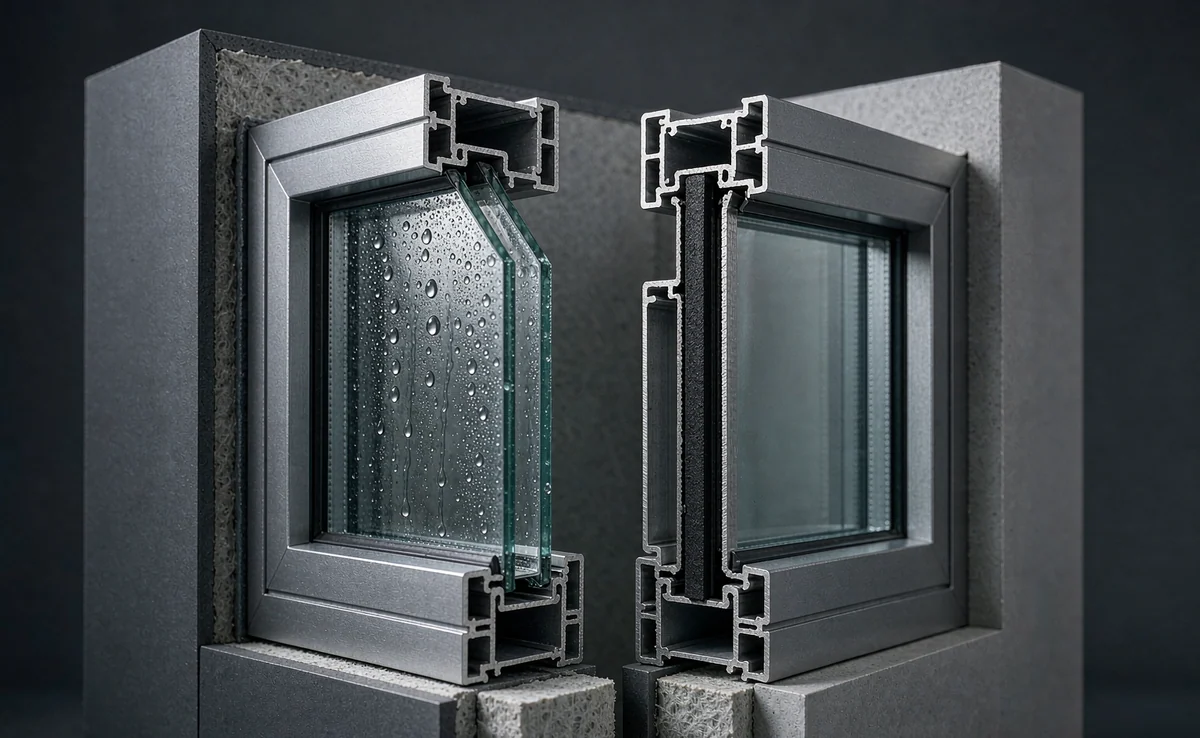
What the strip actually does
Aluminium alloys can provide useful strength at low weight; section geometry, alloy and temper determine structural behaviour. Aluminium also conducts heat readily, which creates a thermal bridge and is a disadvantage for insulation. If the inner and outer frame are one piece of metal, the cold outside face is connected directly to the warm inside face. A polyamide strip breaks that connection, so heat has to cross a less conductive material.
- The strip is usually glass-fibre reinforced polyamide (PA66 GF25).
- It is mechanically joined to both aluminium halves, not pushed in afterwards.
- The frame becomes a composite: metal for structure, polymer for the thermal break.
Where it matters most
In a mild climate with a thermally modest window, the frame is a small part of the total heat loss. In a cold climate, or on a large glazed wall, the frame becomes a visible cold surface: that is where condensation appears first, and where the strip earns its cost.
- Cold climates and high indoor humidity show the difference first.
- Large frames have more metal, so the bridge is bigger.
- Air-conditioned buildings in hot climates also benefit, because the heat path works in both directions.
What it does not do
A thermal-break frame with single glazing is still a poorly insulated window. The glass usually dominates the U-value, the seals decide airtightness, and the installation decides how much of the calculated performance survives on site. Treat the strip as one component, not as a performance guarantee.
- It does not replace insulated glass.
- It does not remove the need for a continuous seal.
- It does not create a certification by itself.
How to check a section
Ask for the section drawing rather than a photograph. The drawing shows the strip width, the glazing pocket and the drainage path. On a physical sample, look for a continuous non-metal band between the two aluminium faces, and confirm the strip is not a thin cosmetic insert.
- Section drawing for the exact series.
- Physical corner sample if the order is significant.
- Drainage path: water must leave the frame, not sit in it.
Thermal break and non-thermal frames compared
| Question | Thermal break | Non-thermal |
|---|---|---|
| Frame heat path | Interrupted by a polyamide strip | Continuous aluminium |
| Condensation assessment | Lower | Higher in cold conditions |
| Typical use | Cold or hot climates, insulated specifications | Mild climates, cost-led projects |
| Cost | Higher | Lower |
| What decides performance | Frame + glass + seals + installation | Glass + seals + installation |