
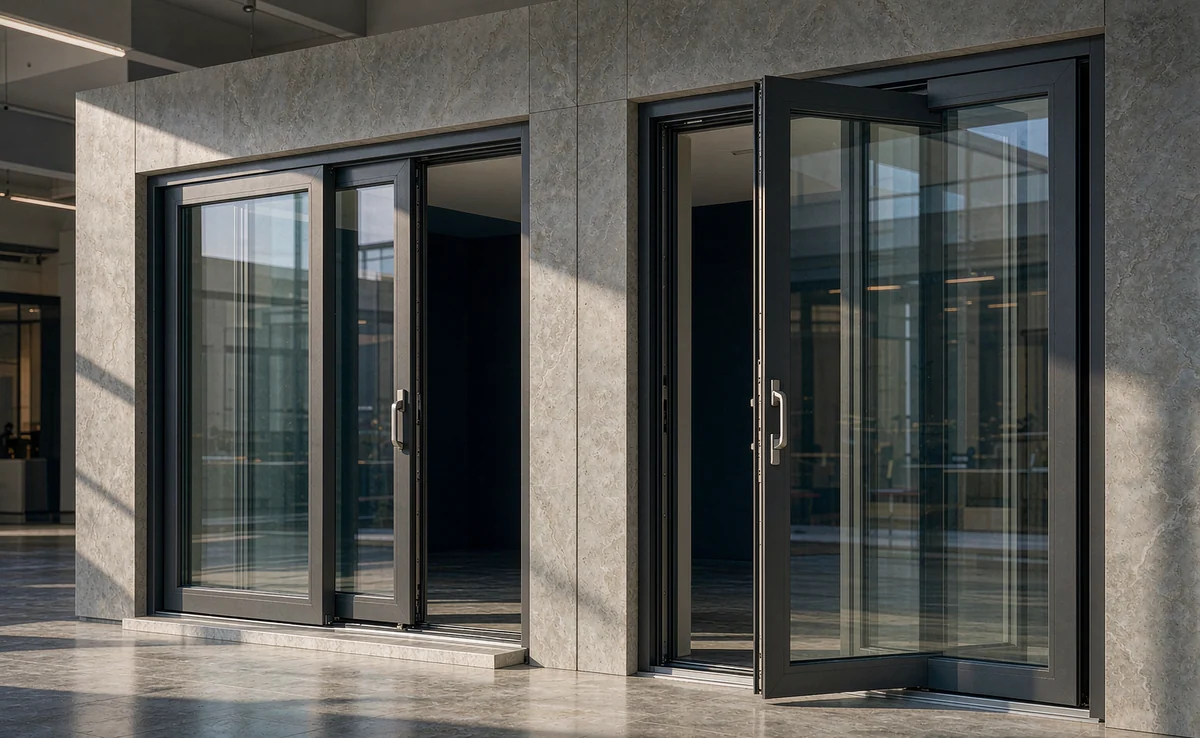
The three movements
A lift-and-slide operation is a sequence, not a single action. Turning the handle lifts the panel a few millimetres, the carriage then takes the weight along a flat rail, and releasing the handle lowers the panel so the gasket compresses. Each step has a purpose.
- Lift: takes the weight off the seal.
- Slide: moves the panel on low-friction bogies.
- Lower: compresses the gasket for the closed position.
Why panel weight decides the mechanism
A hand-moved panel needs low friction. As panels get larger, the glass and frame weight rises quickly, and a standard roller running on a track becomes hard to move and hard to seal. The lift mechanism solves both: the bogie carries the load on a flat rail, and the panel lowers into a compression seal.
- Standard rollers suit moderate panel weights.
- Lift-and-slide hardware has a rated panel weight, stated by the hardware maker.
- Beyond that rating, the answer is more panels or a different system, not a bigger roller.
Sealing and exposure
A brush seal works by contact along a line; a compression gasket works by pressure over a face. The lift-and-slide panel can compress the gasket because it moves vertically at the end of its travel. That is a real advantage on exposed sites, but the sill detail and drainage still have to be right.
- Compression sealing at the sill.
- Drainage chamber under or beside the track.
- Threshold height is a trade-off against water capacity.
When a standard slider is the right answer
If the panels are moderate, the site is sheltered and the opening does not need the best achievable seal, a standard sliding door does the job for less money and simpler maintenance. Specifying lift-and-slide everywhere is a cost decision, not a technical one.
- Moderate panel sizes.
- Sheltered positions or internal use.
- Budget-led projects where the seal target is modest.
Choosing between the two mechanisms
| Question | Standard sliding | Lift and slide |
|---|---|---|
| Panel weight | Moderate | High, within hardware rating |
| Seal type | Brush seal | Compression gasket when lowered |
| Operation | Slide only | Lift, slide, lower |
| Maintenance | Clear the track | Clear the rail, check the lift travel |
| Relative cost | Lower | Higher |